Pickleball Facility Development Canada: From Guidelines to Real-World Results
Pickleball Canada's new Facility Development Guidebook landed on desks across the country last year, and it represents something the sport has needed for years: a comprehensive roadmap for anyone considering a pickleball facility. Released in partnership with IPOP, the guidebook tackles the foundational questions. Should you lease, buy, or build? What makes a facility successful? How do you turn a concept into a community hub?
As someone who's spent the better part of a decade installing courts from backyards to major commercial facilities, I can tell you this guidebook gets a lot right. But there's a difference between knowing the map and having walked the trail. The guidebook tells you where to go. Our job is helping you actually get there, avoiding the expensive detours along the way.
What the Guidebook Gets Right About Facility Development
Let's start with what Pickleball Canada nailed. The guidebook identifies facility shortage as one of the greatest barriers keeping Canadians from playing. When you've got 1.54 million players nationally, representing a 57% increase over three years, the math is simple: we need more courts, and we need them fast.
The guidebook's emphasis on programming as a revenue driver validates what we've learned from our own installations. Take Smash Pickleball in London. We worked with the owners to lay out a 9-court facility built around programming flexibility, enabling them to host everything from beginner clinics to the 2025 Canadian National Pickleball League season opener. That flexibility is what keeps courts busy and members engaged.
And the guidebook's focus on community building captures what pickleball is really about. As we've always said, the sport is about more than the game. It's about the connections people make while playing. The guidebook understands that successful facilities design for those moments both on and off the court.
What Only Experience Can Teach You
Here's where things get interesting. The guidebook provides policy-level guidance, but some lessons only come from installing courts regularly across Ontario and beyond. Let me share a few.
The Curling Rink Pickleball Conversion Nobody's Talking About
When we worked with Glenn Phillips and the Sarnia Golf & Curling Club to add four pickleball courts to their arena, we discovered something remarkable. Their curling rink sat empty every summer, used only for golf bag storage. By installing our TSS Roll Out Courts, a 2.5 mil surface that rolls up and stores in winter, they created year-round value from a seasonal space.
The results? They added 400 new pickleball members. Member satisfaction scores jumped. And their arena transformed from a dark storage area into a bright, vibrant space generating revenue eight months a year.
But here's what made us dig deeper: how many other curling facilities face the same challenge? In November 2023, we surveyed curling clubs across Canada and found that 84% of curlers consider off-season activities important, and 43% expressed keen interest in pickleball specifically. Nearly 40% believed significant demand existed among their members.
That's a uniquely Canadian opportunity the guidebook doesn't address. Thousands of curling facilities sit underutilized for half the year. Many have the perfect dimensions, climate control, and community infrastructure already in place. The TSS Roll Out Courts solve the technical challenge: they accommodate slight subsurface variations that curling ice requires, install in a day, and remove easily when ice-making season returns.
As Glenn told us: "They walked into it as a partner, and I think that was probably one of the most important factors. Because it was new for them, new for us, they were focused on solutions."
Mall Conversions: The Real Story
The guidebook correctly identifies "former industrial buildings, big-box retail locations, vacant malls" as conversion opportunities. What it doesn't tell you is what actually happens when you try to turn a former retail space into an indoor pickleball facility Ontario.
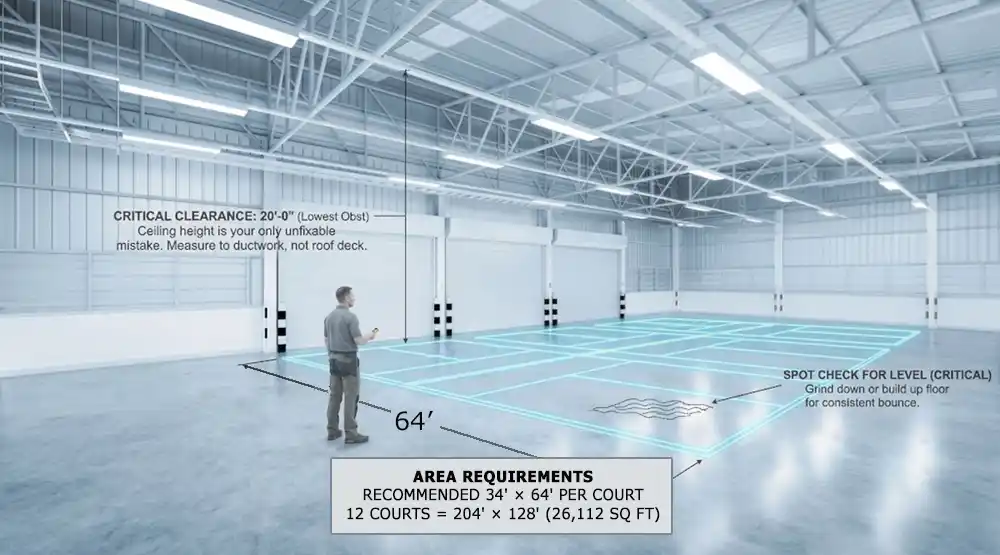
We've installed courts in two major mall conversions. Rally Pickleball in Mississauga's Sherwood Village Mall has 17 courts, and Pickleplex in Barrie's Georgian Mall has 7 courts. Both projects taught us critical lessons about ceiling heights, column spacing, floor conditions, and HVAC considerations that don't show up in planning documents.
Mall floors present challenges that require the same thorough assessment as any installation. Some have been patched repeatedly over decades. Others have drainage slopes built in for cleaning. The condition of the existing floor is just as critical as with any court installation, and should never be assumed to be usable without proper evaluation. Thorough site assessment before signing any lease is essential. Foundation issues can derail timelines and budgets quickly.
Canadian Climate Isn't Just a Talking Point
The guidebook lists surface materials: acrylic, modular tiles, cushioned systems. What it doesn't tell you is which ones actually survive Canadian winters without cracking, heaving, or deteriorating.
We work with pickleball court surfaces Canada's climate demands. Surfaces specifically engineered for freeze-thaw cycles. The materials we select are designed to endure harsh winters and come back strong every spring. We call this approach designing for "seasonal resilience" in outdoor installations.
This matters more than people realize. Choose the wrong surface and you're resurfacing in five years. Choose right and your court lasts twenty-five.
For tournament venues requiring APP (Association of Pickleball Professionals) certification, acrylic surfaces with specific friction coefficients are essential. For community centres serving older adults concerned about joint impact, cushioned or modular tile systems with shock absorption make a meaningful difference. For seasonal installations or facilities testing market demand before committing to permanent courts, the TSS Roll Out Courts offer flexibility no other solution can match.
We've learned to ask clients about their primary user demographic, their programming goals, their budget for long-term maintenance, and their climate considerations. The answers to those questions drive surface selection more than any spec sheet ever could.
The Mistakes We've Seen (So You Don't Make Them)
Over years of pickleball facility development Canada-wide, you witness patterns. Here are the expensive mistakes that show up repeatedly:
Foundation shortcuts. General contractors sometimes suggest cost-cutting measures on drainage or concrete specifications. The short-term savings rarely justify the long-term consequences when water pools or cracks appear.
Lease commitments before proper verification. Someone signs a long-term lease based on listed specifications, only to discover issues with ceiling heights, columns, ductwork, or structural elements that effectively reduce usability.
Ignoring sound mitigation. Pickleball generates roughly 70 dBA at 100 feet, significantly louder than tennis at 40 dBA. Courts built near residential areas without considering orientation, sound barriers, or operating hours can quickly face community complaints that threaten operations.
Underestimating programming importance. The guidebook is right that programming drives revenue at successful facilities. We've seen beautiful courts sit underutilized because operators assumed players would simply show up. You need leagues, clinics, lessons, and community events to keep courts buzzing.
Practical Advice for Guidebook Readers
If you've read the Pickleball Canada guidebook and you're serious about moving forward, here's what we'd recommend:
For Municipal Planners: Consider partnerships with existing underutilized facilities first. Curling rinks, community centres with empty program space, and seasonal outdoor areas all offer opportunities. Rollout courts offer seasonal flexibility. It's faster to market and lower risk than building from scratch.
For Community Organizations: Particularly curling clubs, golf courses with off-season space, and multi-sport facilities. Our research suggests massive untapped demand among your existing membership. The TSS Roll Out Courts let you test the market without permanent commitment. This curling rink pickleball conversion approach has proven successful from Sarnia to facilities across Ontario.
For Private Developers and Franchises: Mall conversions offer unique advantages: built-in parking, existing infrastructure, high visibility. But bring in specialists early. Proper site evaluation before signing a lease can prevent significant issues later. An indoor sports facility Ontario developers are building today needs to account for acoustic treatment, proper ventilation, and surface selection from day one.
For Backyard Enthusiasts: Yes, we do residential courts, and we bring the same commercial-grade thinking to home installations. Proper orientation matters. Drainage matters. Foundation matters. Surface selection matters. A well-built backyard court should last decades, not need replacement in five years.
Our Philosophy: Client-First Advocacy
Here's what differentiates how we work: we are not here to sell what is best for us. We are here to advocate for the client, ensuring they get what they need for long-term success.
Sometimes that means recommending a smaller project than they initially envisioned because the market won't support larger capacity yet. Sometimes it means talking someone out of a premium surface when a mid-tier option will serve their community perfectly well. Sometimes it means being honest that their planned location faces challenges that might make success difficult.
Glenn Phillips at Sarnia said it well: "I always felt as though, if we did hit any major hurdles, we were going to be able to solve it together." That's partnership, not just installation.
What's Next for Canadian Pickleball?
Pickleball Canada's guidebook represents an important milestone. The sport is maturing, infrastructure is being taken seriously, and resources are emerging to help stakeholders make informed decisions.
The next phase is execution. Turning planning documents into actual facilities where Canadians can play. Converting underutilized curling rinks into year-round community hubs. Transforming vacant mall spaces into vibrant pickleball destinations. Building backyard courts that bring families together.
As the Official Court Supplier for Pickleball Ontario and a partner in some of the province's most successful facilities, we're ready to help bring your vision to life, whether that's a single backyard court or a major commercial facility.
The guidebook told you what's possible. Now let's talk about making it real.
You Have the Questions. We Wrote the Answers.
The Pickleball Canada guidebook runs to nearly 90 pages, and it earns every one of them. Two thirds of it is a structured set of questions to work through, and they are the right questions. It asks what ceiling heights an indoor facility needs. It asks how your lighting should meet recommended standards for different levels of play. It asks which court surface will hold up. Then, correctly, it tells you to go ask a specialist.
We are that specialist, so we wrote the answers down. Our two-part white paper series for first-time facility owners covers:
- Ceiling height: the absolute floor, the range where club play actually feels good, and why you measure to the ductwork instead of the roof deck
- Column-free spans: what 60 feet gets you, what 120 feet gets you, and which columns are simply a deal-breaker
- The slab: flatness, moisture vapour, contamination, and the painted floor that has to be ground off completely before any surface goes down
- Outfitting: surfaces, court dividers, safety padding, and lighting levels in foot-candles for recreational, club and tournament play
- Due diligence: the questions to ask any court builder before you hire them
- Two checklists we use ourselves: one to pre-qualify a property while you are standing in it, one to track every outfitting decision through to opening day
Tell us about your site and what you are planning. We will send you both papers, and we will tell you what we make of your specific situation. Two minutes, no obligation.
Tell Us About Your ProjectFrequently Asked Questions About Pickleball Facility Development in Canada
How much does it cost to build a pickleball facility in Canada?
Costs vary significantly based on whether you're converting existing space or building from scratch. A curling rink pickleball conversion using rollout courts can start around $50,000-$75,000 for a 4-court setup. Indoor pickleball facility Ontario projects in mall spaces typically range from $200,000-$500,000 depending on court count and amenities. New construction facilities can exceed $1 million. Site assessment, surface selection, and climate control significantly impact final costs.
What's the best surface for outdoor pickleball courts in Canada?
For Canadian climates, you need pickleball court surfaces Canada's freeze-thaw cycles won't destroy. We recommend either acrylic surfaces specifically engineered for temperature fluctuations or SnapSports modular tiles with ShockTower technology. Both expand and contract with weather changes without cracking. Avoid generic surfaces not rated for Canadian winters. A quality surface costs more upfront but lasts 20-25 years versus 5-7 years for cheaper alternatives.
Can you really convert a curling rink into a pickleball facility?
Absolutely. We've successfully completed curling rink pickleball conversion projects that added hundreds of members and generated year-round revenue. The key is using rollout court systems like TSS Roll Out Courts that accommodate the slight subsurface variations curling ice requires. These systems install in a day, store compactly during ice season, and let curling clubs monetize empty summer months without permanent modifications.
How long does it take to build an indoor pickleball facility?
Timeline depends on your starting point. Rollout court installations in existing spaces take 1-2 days. Mall conversions with required renovations typically need 3-6 months from lease signing to opening. New construction projects can take 12-18 months. The longest phase is usually permitting and site preparation, not actual court installation. Working with experienced installers who understand local requirements significantly shortens timelines.
What should I look for in a pickleball court builder?
Look for builders with documented commercial installations, not just backyard experience. Ask about their approach to foundation work, drainage, and climate-appropriate surface selection. Check if they understand programming requirements and can design for flexibility. Most importantly, find partners who advocate for your long-term success rather than just selling you a court. References from community centres, curling clubs, or commercial facilities are more valuable than residential testimonials.
Do I need APP certification for my pickleball courts?
Only if you plan to host sanctioned tournaments. APP (Association of Pickleball Professionals) certification requires specific court dimensions, surface friction coefficients, and net specifications. Most community facilities and recreational spaces don't need certification. However, building to these standards ensures your courts can host higher-level play if opportunities arise. Discuss your programming goals with your installer to determine if certification makes sense for your facility.